

Why Transformation Programmes Fail Before They Start, and What Structured Diagnostics Change
Most transformation efforts do not fail during execution. They fail earlier, during the diagnostic phase, when the wrong questions are asked, when assumptions go unexamined and when critical decisions are made on incomplete evidence. The result is a cycle of enterprise transformation programmes that consume capital and management attention without materially improving clarity. The root cause, in most cases, is not a lack of effort. It is the absence of structured transformation diagnostics capable of producing governed, evidence-based conclusions.
This article explains the structural problems in how transformation diagnostics are typically conducted, and introduces the approach behind the Qaltron Transformation Solution built into the CaaP platform.
The Problem with Traditional Transformation Diagnostics
Organisations spend significant time and capital on diagnostic work that is, in most cases, difficult to repeat, difficult to verify and difficult to build upon. The failure modes are consistent and well understood, yet they persist.
Diagnostic Ambiguity
Many diagnostic outputs rely on subjective assessments without a consistent scoring methodology. When two assessors examine the same organisation, they frequently produce different conclusions, not because the organisation has changed, but because the reasoning was never structured to begin with.
Consultant Dependency
Diagnostic insight often resides in the experience and judgment of individual consultants rather than in documented, governed processes. When those individuals move on, the institutional knowledge leaves with them. The organisation is left with a strategy deck but no way to interrogate the reasoning behind it.
Non-Repeatable Reasoning
If a diagnostic cannot be repeated with consistent results, it is not a diagnostic. It is an opinion. Most traditional approaches do not distinguish between the two, and boards are rarely given the information they need to tell the difference.
Lack of Evidence Traceability
Strategy decks are presented as conclusions. The evidence that supports those conclusions is rarely traceable. When boards or regulators ask how a specific recommendation was reached, the answer is often a reference to experience rather than a documented chain of reasoning.
Strategy Without Analytical Grounding
The distance between raw evidence and final recommendation is where credibility is established or lost. Without structured analytical grounding, strategy becomes a function of persuasion rather than substance.
The Qaltron Transformation Solution
The Qaltron Transformation Solution, delivered through the CaaP platform, is designed to address these specific weaknesses. It does not attempt to replace the judgment of senior leaders. It provides them with better material to exercise that judgment against.
Structured Diagnostic Logic
Every assessment follows a defined analytical framework. The Legacy-Logic Mapping (LLM) Framework decomposes organisational capability across fifteen components, each assessed against explicit diagnostic criteria. The framework produces three sub-indices, the Strategic Legacy Score (SLS), Cultural Alignment Score (CAS) and Strategic Anchors Score (SAS), which combine into a composite measure: the Legacy Coherence Score (LCS).
The current platform presents these outputs through a structured scoring environment that makes executive interpretation easier. Rather than abstract scoring in the background, decision-makers can directly see the assessment scores, sub-index signals, and how different parts of the organisation contribute to the broader transformation picture.

Governed Reasoning
The reasoning process is deterministic. Given the same inputs and evidence base, the system produces the same outputs. This is not a feature of convenience. It is a governance requirement. Boards, auditors and regulators can review the reasoning chain and confirm that conclusions follow from evidence rather than from assumption.
Evidence-Weighted Outputs
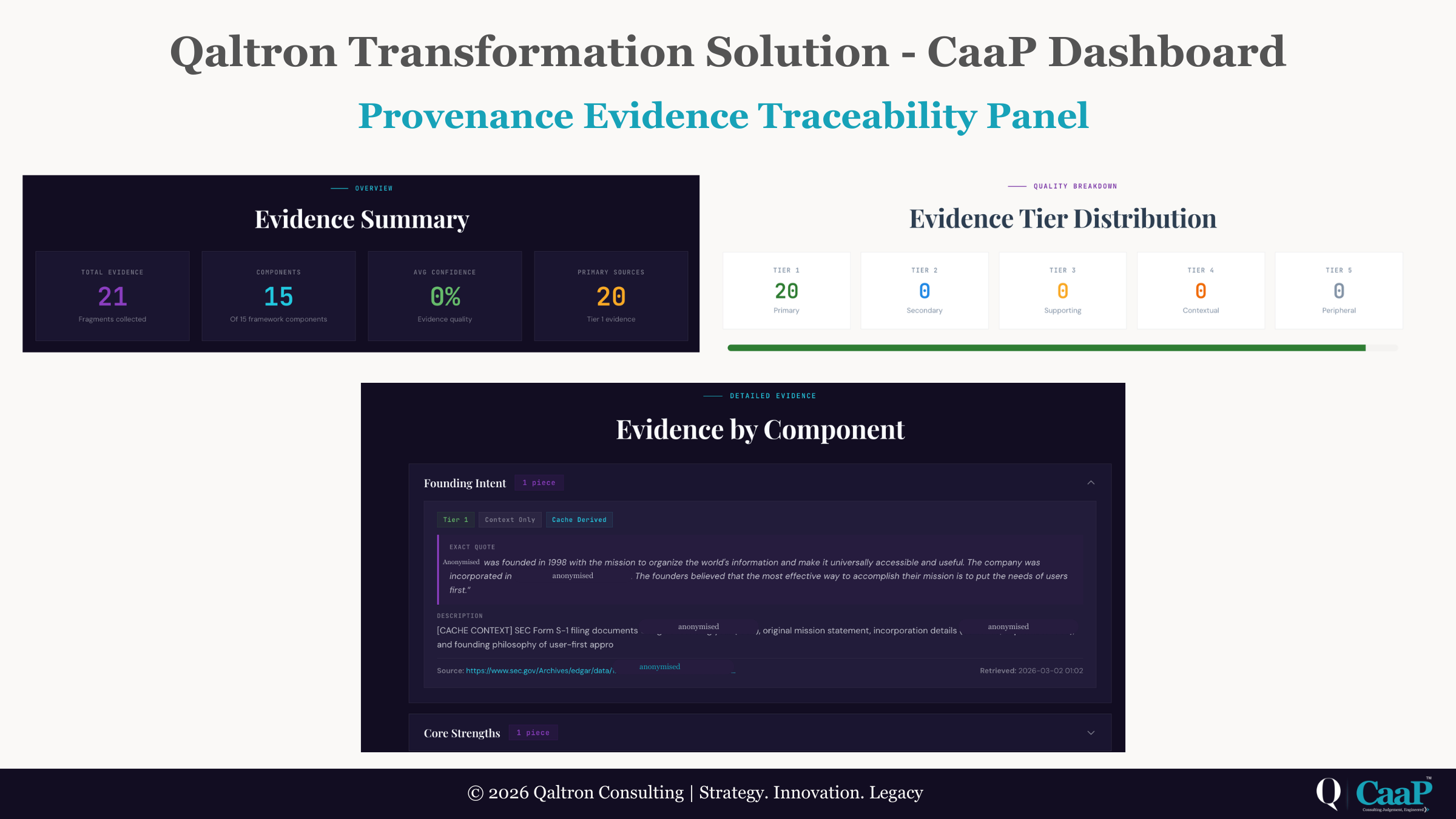
Every score and every recommendation is traceable to specific evidence. The platform retrieves, classifies and structures source material before scoring occurs. The evidence chain is preserved and accessible, creating a clear line from source material to extracted evidence, diagnostic interpretation and final output.
This matters because credibility in transformation work is not established only by conclusions. It is established by showing how those conclusions were formed.
Board-Ready Executive Dossier and Structured Reporting
Outputs are produced in structured, professional formats suitable for board review, leadership discussion and downstream transformation planning. The current platform supports a board-ready executive dossier environment, where assessment signals, comparative intelligence, executive interpretations, and diagnostic modules can be reviewed in a more navigable and decision-oriented format.
This moves reporting beyond static narrative. Leaders can engage with diagnostic signals, review evidence-backed observations, and move toward prioritised intervention areas in a structured way.

Deterministic and Repeatable Analysis
The same organisation assessed today and reassessed next quarter will produce comparable results, adjusted only for genuine changes in evidence. This repeatability is what transforms a diagnostic from a one-off engagement into a governed measurement capability.
What This Changes for Decision Makers
The value of structured diagnostics is measured not in features but in outcomes.
Reduced Decision Uncertainty
When scores are evidence-based and reasoning is transparent, senior leaders can make resource allocation decisions with greater confidence. The gap between “we think” and “we know” narrows considerably.
Faster Executive Clarity
Time spent debating the validity of diagnostic conclusions is time not spent acting on them. Structured outputs reduce the interpretation overhead and accelerate the path from assessment to intervention.
Lower Transformation Waste
Programmes that begin with clear, evidence-grounded diagnostics are less likely to pursue the wrong priorities. The cost of correcting a misdiagnosis mid-programme is typically several multiples of the cost of getting the diagnostic right in the first place.
Institutional Memory Capture
Every assessment becomes a permanent, queryable record. Organisations build a longitudinal view of their transformation trajectory rather than starting from zero with each new engagement or leadership change.
Structured Intervention Prioritisation
Risks and gaps are more useful when they lead to focused action. The platform is designed to help leadership teams move from diagnostic signals to priority areas for intervention, rather than leaving transformation outputs as broad narrative observations.
This enables a more disciplined form of transformation planning. Rather than launching unfocused initiatives across the enterprise, decision-makers can focus on the areas where evidence indicates the most meaningful constraints, dependencies or opportunities for improvement.
Benchmarking Workspace and Advanced Analytics
Executives need more than a score. They need context. The current platform extends beyond individual assessment output into a broader benchmarking and analytics environment, enabling comparative intelligence across assessments, peer sets, and available portfolio views. Whether comparing industry, regional or broader market performance, the platform provides the comparative context needed to interpret diagnostic signals more meaningfully.
The benchmarking workspace allows users to move from a single diagnostic result toward relative interpretation. This helps leadership teams understand whether a weakness is enterprise-specific, sector-shaped, or part of a broader performance pattern. Advanced analytics further support portfolio-level review, comparative positioning and more structured decision support.

What Qaltron CaaP Is Not
Clarity about what the platform does not do is as important as explaining what it does.
CaaP is not generic AI. The platform is built on proprietary analytical frameworks developed through years of consulting practice. It is not a chatbot, not a summarisation tool and not a general-purpose language model applied to business questions.
CaaP does not replace executive judgment. It provides structured inputs to that judgment. The decision to act, the choice of intervention, the allocation of political capital within an organisation: these remain firmly within the domain of leadership.
CaaP is not consulting theatre. There are no hundred-page strategy decks designed to justify fees. Every output exists because it serves a diagnostic, governance or decision-making purpose. If it does not contribute to clarity, it is not included.
Explore Qaltron CaaP Platform or Register Your Interest Today!
Transformation is difficult enough when the diagnosis is correct. When it is not, the cost compounds with every subsequent decision built on that flawed foundation.
The discipline of structured diagnostics is not new. What has been missing is a way to apply that discipline consistently, at scale, with full evidence traceability and without dependence on individual consultants. The Qaltron Transformation Solution was built to close that gap.
The organisations that will navigate the next decade successfully will be those that treat diagnosis as infrastructure, not as a preliminary exercise. They are the ones that begin with the clearest understanding of where they actually stand.
To explore the platform or request a guided walkthrough of the diagnostic process, visit Qaltron CaaP Platform. Request for a guided walkthrough, contact Qaltron Inc.. For platform access, Register Your Interest Here.
Frequently Asked Questions
How is the Legacy Coherence Score calculated? The LCS is a weighted composite of three sub-indices: the Strategic Legacy Score, Cultural Alignment Score and Strategic Anchors Score. Each sub-index is derived from scored assessments across fifteen organisational components, with scores weighted by evidence quality and source reliability. The full methodology is documented within each assessment report.
Can CaaP be used for regulated industries? Yes. The platform was designed with regulated environments in mind. Every score is traceable to specific evidence, and the full reasoning chain is preserved for audit purposes. Outputs are structured for direct inclusion in board papers and regulatory submissions.
How long does a full diagnostic assessment take? A standard assessment typically completes within minutes of initiation, depending on evidence availability and scope. The platform retrieves and analyses evidence, applies the LLM Framework scoring methodology, and produces structured outputs including assessment scores, executive dossier views, benchmarking intelligence, and board-ready reporting.
What is the difference between CaaP and traditional consulting diagnostics? Traditional diagnostics depend on individual consultant judgment and are difficult to repeat or verify. CaaP produces deterministic, evidence-weighted outputs using a governed analytical framework. The same organisation assessed twice against the same evidence base will produce the same scores. This repeatability is what allows organisations to track transformation progress over time rather than relying on periodic, subjective reassessment.
Proprietary Notice & Trademark Disclaimer
Legacy-Logic Mapping™, Legacy Coherence Score™ (LCS), Strategic Legacy Score™, Cultural Alignment Score™, Strategic Anchors Score™, and all associated frameworks, indices, methodologies, and terminologies are proprietary protected trademarks and intellectual property exclusively owned by Qaltron Inc.
No part of this content nor any related materials, descriptions, diagrams, outputs, or derivative works—may be copied, reproduced, distributed, transmitted, displayed, performed, adapted, modified, published, licensed, sold, or otherwise exploited, in whole or in part, in any form or by any means, without the prior express written permission of Qaltron Inc.
Unauthorized use is strictly prohibited and may constitute infringement of intellectual property rights under applicable laws.
© 2026 Qaltron Inc. All rights reserved.